As a dedicated provider in the metal cutting industry, I’ve witnessed firsthand the indispensable role that metal cutting band saws play in various manufacturing and fabrication processes. In this blog, I’ll delve into the working principle of a metal cutting band saw, shed light on its key components, and explain how these elements work in harmony to achieve precise and efficient metal cutting. Metal Cutting Band Saw

Key Components of a Metal Cutting Band Saw
Before we dive into the working principle, let’s first take a look at the main components of a metal cutting band saw. Understanding these parts is crucial because they each have a specific function that contributes to the overall operation of the saw.
Band Blade
The band blade is perhaps the most critical component of the metal cutting band saw. It is a continuous loop of toothed metal that does the actual cutting. The teeth on the blade are designed to chip away at the metal as the blade moves. The pitch of the teeth (the distance between each tooth) and the tooth geometry are carefully selected based on the type of metal being cut and the desired cutting speed and finish. For instance, finer tooth pitches are generally used for thinner materials or when a smoother cut finish is required, while coarser tooth pitches are better suited for thicker materials or when speed is more important than finish.
Guide Wheels
The guide wheels are responsible for supporting and guiding the band blade along its path. They ensure that the blade remains in the correct position and alignment as it moves around the machine. typically made of a durable material like steel or a high – strength composite. The guide wheels are precisely machined to have a smooth surface and the correct diameter and width to match the band blade. Proper alignment of the guide wheels is essential to prevent the blade from wandering off course during cutting, which could lead to inaccurate cuts and premature blade wear.
Guide Blocks
Guide blocks are located near the cutting area and serve to stabilize the band blade as it enters the workpiece. They are usually made of a hard, wear – resistant material such as carbide or a special polymer. The guide blocks are adjustable to accommodate different thicknesses and widths of band blades. By keeping the blade in a straight and stable position during cutting, the guide blocks help to improve the accuracy and quality of the cut, reduce vibration, and extend the life of the blade.
Drive Motor
The drive motor is the power source that drives the movement of the band blade. It provides the necessary torque and rotational speed to move the blade at a consistent rate. The power of the drive motor is chosen based on the size of the band saw, the type of metal to be cut, and the required cutting speed. Different types of motors can be used, such as electric motors, which are common in most industrial and workshop settings due to their reliability and ease of control.
Feed System
The feed system is responsible for moving the workpiece into the cutting area at a controlled rate. This can be either a manual feed system, where an operator manually adjusts the position and speed of the workpiece, or an automatic feed system. Automatic feed systems are more precise and efficient, especially in high – volume production environments. They use mechanisms such as hydraulic or servo – controlled systems to ensure a consistent and accurate feed rate.
Frame and Base
The frame and base of the metal cutting band saw provide the structural support for all the other components. They are typically made of heavy – duty steel or cast iron to ensure stability and durability. A solid frame and base are essential to minimize vibration during cutting, which can affect the accuracy and quality of the cut. The design of the frame also takes into account factors such as the accessibility for maintenance and the overall footprint of the machine in a workshop or production facility.
Working Principle of a Metal Cutting Band Saw
Now that we understand the key components, let’s explore how they work together to make the metal cutting band saw function.
Blade Movement
The process begins when the drive motor is turned on. The drive motor rotates one of the guide wheels, which in turn drives the continuous band blade around a loop formed by the guide wheels. The blade moves in a unidirectional manner, with the teeth facing the workpiece and moving towards it. Depending on the type and size of the band saw, the blade speed can be adjusted to suit different cutting requirements. For example, when cutting softer metals, a higher blade speed can be used to increase productivity, while harder metals may require a slower blade speed to prevent overheating and premature blade wear.
Workpiece Positioning
Once the blade is in motion, the workpiece is positioned beneath the band blade. This is usually done with the help of the feed system, which ensures that the workpiece is accurately aligned with the path of the blade. If a manual feed system is being used, the operator carefully maneuvers the workpiece, making sure that it is straight and at the correct angle to the blade. In an automatic feed system, the workpiece is placed on a table or fixture, and the system moves it forward at a pre – set rate.
Cutting Process
As the workpiece moves into the path of the rotating band blade, the teeth of the blade start to engage with the metal. Each tooth on the blade acts like a small cutting tool, chipping away at the metal as it passes over the workpiece. The shape of the teeth is designed to efficiently remove material and expel the chips from the cutting area. The cutting fluid, which is often used during the process, serves multiple purposes. It cools the blade and the workpiece to prevent overheating, lubricates the cutting surface to reduce friction, and helps to flush away the chips.
Chip Removal
During the cutting process, one of the challenges is to ensure proper chip removal. If the chips are not removed effectively, they can accumulate in the cutting area, causing friction, heat build – up, and potentially damaging the blade and the workpiece. The design of the band blade’s tooth geometry, along with the flow of the cutting fluid, helps to carry the chips away from the cutting area. Additionally, some advanced band saws are equipped with chip conveyors or suction systems to further enhance chip removal efficiency.
Monitoring and Control
Throughout the cutting process, operators need to monitor various parameters to ensure optimal performance. This includes checking the blade tension, which should be maintained at the correct level to prevent blade breakage or wandering. The feed rate and blade speed also need to be adjusted according to the material properties, thickness, and the desired cutting quality. In modern metal cutting band saws, many of these parameters can be monitored and controlled automatically using sensors and control systems, which provide real – time feedback and can make adjustments as needed.
Applications and Advantages of Metal Cutting Band Saws
Metal cutting band saws are used in a wide range of industries, including automotive, aerospace, construction, and general manufacturing. Their versatility allows them to cut various types of metals, such as steel, aluminum, brass, and copper, as well as different shapes and sizes of workpieces.
One of the main advantages of metal cutting band saws is their high precision. The stability provided by the guide wheels and guide blocks, along with the consistent feed rate, enables accurate and repeatable cuts. This is crucial in industries where tight tolerances are required. Another advantage is their efficiency. Band saws can cut through thick materials relatively quickly, especially when compared to some other cutting methods. They also produce less waste material due to their narrow kerf (the width of the cut made by the blade), which can lead to cost savings in the long run.
Conclusion
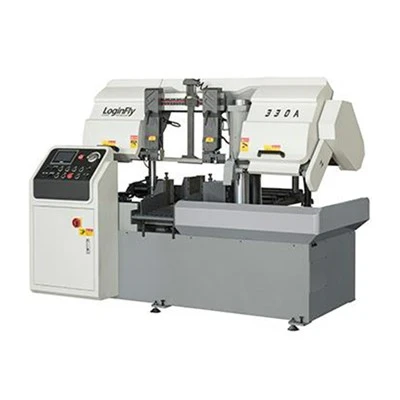
In conclusion, the working principle of a metal cutting band saw is a complex interplay of multiple components working in harmony. From the blade movement to the chip removal, each step is carefully designed to achieve efficient and precise metal cutting. Whether you are in a small workshop or a large industrial manufacturing plant, a metal cutting band saw can be a valuable asset.
Vertical Band Saw Series If you are in the market for a high – quality metal cutting band saw, or if you have any questions about our products and how they can meet your specific cutting needs, I encourage you to reach out to our sales team for further discussions. We are committed to providing you with the best solutions and support in the metal cutting field.
References
- "Manufacturing Engineering and Technology" by Serope Kalpakjian and Steven R. Schmid
- "Machinery’s Handbook" by Industrial Press Inc.
- Technical manuals of various metal cutting band saw manufacturers
Shanghai Loginfly Sawing Technology Co., Ltd.
As one of the most professional metal cutting band saw manufacturers and suppliers in China, our products have good reputation in the market. We warmly welcome you to wholesale premium metal cutting band saw from our factory. If you have any enquiry about cooperation, please feel free to email us.
Address: Room 506 NO.655 Yinxiang Road,Nanxiangtown,Jiading District, Shanghai.China
E-mail: sales01@loginfly.com
WebSite: https://www.loginflysaws.com/
