If you’ve ever been involved in building a high-speed data center, a 5G wireless network, or even a complex enterprise cabling system, you’ve probably run into MPO and QSFP connectors. As someone who’s spent the last decade supplying MPO/MPT fiber optic cables and working directly with cabling engineers, data center managers, and network designers, I can tell you these two components are often confused—even by people who’ve been installing fiber for years. It’s a mistake that can lead to costly rework, delayed projects, and even network outages, so breaking down exactly what sets them apart isn’t just a tech geek exercise. It’s critical for anyone putting together a reliable high-speed fiber network. MPO/MPT Fiber Optic Cable
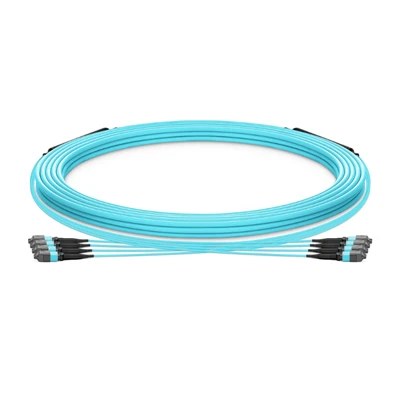
Let’s start with the basics I get asked about every week as a fiber supplier: what each connector is designed to do. MPO stands for Multi-fiber Push-On, and it’s a connector that groups multiple optical fibers into a single, compact housing. A standard MPO connector holds 12 or 24 fibers, but you can also get 8-fiber or 36-fiber variants depending on the application. It’s built for bulk fiber connections, so instead of plugging in 12 separate LC connectors one by one, you plug one MPO connector and you’re done. That cuts installation time drastically, which is why data center managers love it when they’re wiring dense rack environments. MPT, by the way, is Multi-fiber Push-Twist— it’s a slightly newer variant that has a twist-lock mechanism instead of MPO’s push-lock, designed to reduce accidental disconnections in high-vibration environments like server racks on factory floors.
QSFP, on the other hand, is a small form-factor pluggable transceiver, not exactly a “connector” in the same way MPO is. Wait, that’s a key point I always clarify with new clients: QSFP stands for Quad Small Form-factor Pluggable, and it’s a module that plugs into a port on a switch, router, or server, and connects to fiber cables using a connector at the end. The confusion comes because the most common cable for QSFP modules uses an MPO connector at one end to link to the transceiver. So people mix them up because they’re often used together, but they serve totally different roles.
Now, let’s dive into the practical differences that matter for your project, not just textbook definitions. First, fiber count and density. MPO connectors excel here. A single MPO can handle 12 or 24 fibers in a space that’s about the size of a standard LC duplex connector—so you get 12x the fibers in the same footprint. For data centers, where every rack U (unit of space) is precious, that means you can fit more connections in fewer panels, reducing the number of cable runs and clutter. QSFP transceivers, on the other hand, are designed to transmit multiple data channels at once. A QSFP+ module, for example, does 4 channels, each running up to 10 Gbps, for a total of 40 Gbps. QSFP28 bumps that to 4 channels of 28 Gbps, hitting 100 Gbps, and QSFP-DD goes up to 400 Gbps. So QSFP is about speed per channel and modularity, while MPO is about bundling lots of fibers into one connection point.
Next up, installation and compatibility. Let’s be honest, I’ve seen installers mess up MPO connections more than any other part of a fiber build—usually because they don’t understand the polarity. MPO connectors use keyed housings to align the fibers correctly, and there are three main polarity types: Type A, Type B, and Type C. If you plug a Type A MPO into a Type B, the entire link fails, and you’re crawling around a dark data center rack replacing cables at 2 a.m. That’s where a lot of my clients come to me when they’ve already ordered the wrong MPO cables—they don’t realize polarity isn’t universal. QSFP modules are more plug-and-play in that sense, but they have their own compatibility rules. Different QSFP generations (QSFP+, QSFP28, QSFP-DD) have different port sizes, so you can’t just plug a QSFP28 into a QSFP+ port. Also, passive vs active QSFP cables matter: passive direct attach cables (DAC) are short, cheap, and work up to 10 meters, while active optical cables (AOC) can go much farther, up to 100 meters, which makes them better for cross-rack connections.
Then there’s distance and use case. MPO connectors are all about fiber runs, so the distance a cable can travel depends on the type of fiber inside—OM3, OM4, OM5 for multimode, or single-mode. A 24-fiber MPO cable with OM4 can run up to 150 meters at 100 Gbps, while single-mode MPO can go kilometers. QSFP modules tie that speed to the device port. For example, a QSFP28 paired with an MPO cable can deliver 100 Gbps over 100 meters with AOC, but if you need to go farther than that, a QSFP-DD with single-mode MPO will get you to 400 Gbps over several kilometers. Where you’ll see MPO stand alone is in backbone cabling: data centers use MPO trunks to connect core switches to edge racks, and then break out MPO to LC connections for individual servers. QSFP is at the edge: each server port uses a QSFP module, which links via MPO to the backbone. I see this every day in my work—MPO is the backhaul, QSFP is the end device connection.
Common myths I have to debunk all the time: first, that MPO is only for data centers. It’s not—MPT connectors, the updated version, are used in 5G small cell sites because they’re more durable for outdoor installations, and MPO is also used in high-performance computing (HPC) clusters where thousands of fibers need to be connected quickly. Another myth is that QSFP is a type of fiber connector. No, QSFP is a transceiver, so the connector on the end of the QSFP cable is usually MPO, sometimes LC for smaller ports. That mix-up causes so many orders for mismatched parts. Last year, a 5G contractor reached out to me after ordering QSFP cables thinking they could plug them straight into a fiber panel—they didn’t realize they needed MPO adapters to make it work. It’s a mistake that costs time and money, so I always take time to explain that upfront.
What about cost and scalability? As a supplier, I can tell you that MPO cables are generally cheaper per fiber than individual LC runs, because you’re using one connector housing instead of multiple. For a 12-fiber run, one MPO connector is cheaper than 12 LC connectors, and installation takes a fraction of the time. QSFP modules are a different story—they’re specialized hardware, so the cost per port depends on the speed. A QSFP+ 40 Gbps module is cheaper than a QSFP-DD 400 Gbps, but as speed increases, so does the module cost. Scalability also works differently: if you need to upgrade from 40 Gbps to 100 Gbps, you can often just swap out the QSFP module without changing the MPO backbone cabling, which is a huge saving for existing data centers. That’s why so many clients choose to deploy MPO as their base cabling—they can upgrade the edge QSFP modules as needed, instead of re-running all the fiber.
Let’s wrap this up with a real-world example I saw last quarter. A mid-sized e-commerce company was expanding their data center from 20 to 50 racks. They originally planned to use individual LC connectors for every server, which would have required 20,000+ connectors and hundreds of hours of installation. Instead, we worked with them to use 24-fiber MPO backbone cables, with QSFP28 modules at each server. That cut their connector count by 90%, reduced installation time by 60%, and left them room to scale up to 400 Gbps later by just swapping the QSFP modules and upgrading a few MPO adapters. They saved over $120,000 in cabling and installation costs, and they told me they didn’t have a single connectivity issue during their launch. That’s the value of knowing when to use MPO vs QSFP.

At the end of the day, MPO and QSFP are complementary, not competing, parts of a high-speed fiber network. MPO is for bundling fibers into efficient, high-density runs, perfect for backbone and trunk cabling. QSFP is the modular transceiver that connects those fibers directly to servers, switches, and other devices, offering scalable speed per port. The biggest mistakes I see are when people treat them as interchangeable—trying to use QSFP cables for backbone runs, or ordering the wrong MPO polarity without checking their equipment specs. If you’re planning a new network or upgrading an existing one, don’t guess which connector you need. Reach out to me, and I can help you walk through your use case, from MPO trunks to QSFP modules, to make sure you get the right components that fit your budget and performance needs.
Fiber Optic Connectors References:
- Telecommunications Industry Association (TIA). TIA-568-C.3: Optical Fiber Cabling Standard.
- IEEE. 802.3bm-2015: Ethernet Standard for 40 Gb/s and 100 Gb/s Operation.
- Fiber Optic Association (FOA). Multi-fiber Connector (MPO) Installation Guide.
- 5G Americas. Small Cell Backhaul Cabling Requirements for 5G Networks.
- Data Center Infrastructure Dynamics. 2023 Global Data Center Cabling Market Report.
Shenzhen Dimi Telecommunications Co., Ltd.
As one of the most professional MPO/mpt fiber optic cable manufacturers and suppliers in China, our products have good reputation in the market. Please rest assured to wholesale advanced MPO/mpt fiber optic cable made in China here from our factory. Also, custom service is available.
Address: China
E-mail: sales@dimifiber.com
WebSite: https://www.dimi-fiber.com/
