Hey, guys! Let’s cut to the chase – if you run a playground (whether it’s a small local rec center, a private school, or even a community park you manage), you know those rope elements don’t just hold themselves together. I’ve been in the rope playground supply game for over 10 years now, and let’s be real: broken ropes are par for the course. Kids climb hard, weather beats on ’em, and sometimes even a random sharp stick snags a strand that turns into a full fray. I see so many people either panicking and trying a janky knot that fails in a week, or waiting way too long and turning a tiny fix into a whole new rope purchase. Today, I’m walking you through the only reliable way to repair a broken playground rope – no fancy tools, no confusing jargon, just stuff you can grab from a hardware store or your own supply closet. Rope Playground

First, let’s get one thing straight: not all rope breaks are equal. This isn’t the same as fixing a frayed extension cord or a craft rope for a kid’s project. Playground rope is usually high-density polypropylene, sometimes polyester – stuff that’s built to hold 500+ pounds per inch, so your fix has to match that strength. I’ve seen too many folks use paracord, and while that works for keychains, it’s way too thin for a playground. Skip that, and let’s break this down step by step, starting with the pre-repair checks that’ll save you a lot of headaches.
First step: Inspect the damage (before you touch anything). Grab a pair of work gloves (those thin latex ones won’t cut through frayed strands) and head to the rope. Let’s distinguish between three types of breaks, because each needs a slightly different approach:
- Frayed strands (no full snap, just loose fibers sticking out): This is the easiest fix, but even here, you can’t just snip them off and call it good.
- Partial snap (half the rope is intact, the other is hanging loose): You’ve got to reinforce both sides here, because the remaining half is already weak.
- Full break (rope is split completely, two separate ends hanging): This is the big one – you can’t use a simple here’s a knot fix, you need a splice that’s as strong as the original rope.
Wait, quick pro tip I learned early: never repair a rope that’s got more than one full break within a 3-foot section. If that’s the case, just replace that segment – it’s cheaper than waiting for a second repair to fail and hurting someone. Also, while you’re inspecting, note how old the rope is. Polypropylene rots after 7-10 years, so if your rope is pushing 12, even a perfect repair won’t last – just buy a new one. I’ve had clients try to patch a 15-year-old rope, and within a month, it snapped again mid-climb. Save yourself the trouble.
Next, gather your supplies – no specialty playground gear required, I promise. Here’s what you need:
- The same type of rope as your original playground rope. Wait, why same? Because polypropylene stretches differently than polyester, and mixing types will make your fix uneven. If you don’t have spare rope on hand, head to a hardware store and grab the exact diameter (usually 1/2 inch to 1 inch for playground use) of what you’ve got.
- A sharp utility knife or rope cutter (scissors won’t work – they’ll leave frayed ends instantly).
- A bottle of super glue (clear, gel type – not the runny stuff, it’ll seep through the strands) or a heat source (a small propane torch, or even a lighter if you’re careful).
- Work gloves (non-negotiable – those cut strands can slice your fingers, I’ve done it too many times).
- Measuring tape (you’ll need a few inches extra for the repair).
- Optional: A wooden dowel or a small screwdriver to help tuck strands under – nothing fancy.
Now, let’s get into the actual repairs, starting with the most common: full break. This is the one you’ll use 90% of the time, and it’s called a “bury splice” – it’s the standard for playground ropes because it doesn’t create a bulky knot that can catch a kid’s clothing (we’ve all heard of a hoodie getting stuck on a knot mid-climb – yeah, we avoid that at all costs).
Step 1: Prep the ends. Lay your broken rope out on a flat surface (grass works, no need for a table) so the two ends are lined up straight, no twists. Snip each end with your utility knife – make a clean, straight cut, not an angle. If there are frayed strands, snip those too, but don’t go too short. Now, take your spare rope (the same diameter) and cut a 3-foot length of it. That might seem like overkill, but 1.5 feet on each side of the splice is exactly what you need to make it strong.
Step 2: Thread the splice. Take one end of your broken rope, and spread the outer strands (the “sheath”) open just a little – don’t pull them all apart, you’ll ruin the rope. Now, take the end of your 3-foot spare rope, and tuck it into the center of the broken rope. Push it in about 1 foot, so half the spare rope is inside one end of the broken rope, half is hanging out the other side. Now, take the other end of the broken rope, spread its sheath, and tuck the free end of the spare rope into it, also pushing 1 foot deep. Now you’ve got a splice where the spare rope is running through the middle of both broken ends.
Step 3: Tuck and trim. Here’s the tricky part, but it’s easy once you get the hang of it. On each side of the splice (so 1 foot from the center), you’ve got the outer strands of the broken rope. Take the hanging end of the spare rope, and weave it through those outer strands like a braid – pull each small strand of the spare rope under one outer strand of the broken rope, then over the next, and so on, for a few inches. Do this on both sides. Now, cut the loose ends of the spare rope so they’re flush with the broken rope’s strands – no extra bits sticking out.
Step 4: Secure it. This is what makes the splice permanent. If you’re using glue, put a tiny drop of gel super glue on every few strands – not too much, it’ll seep and make the rope stiff. If you’re using heat, hold a lighter (or torch, on low) about an inch away from the splice, just to melt the outer strands of the broken and spare rope together. Don’t hold the flame too long – you’ll burn a hole through the rope, and that’s worse. Let it cool for 5 minutes, then give the splice a gentle tug – it shouldn’t move at all. That’s it – no knot, no bulk, strong enough for even 10-year-olds swinging from it.
Wait, what if your damage is just frayed strands, no full break? That’s even faster. Let’s do that: First, snip all the loose frayed strands as close to the main rope as you can (don’t snip into the working part). Then, take your spare rope’s end, melt it with a flame just a tiny bit so it’s not frayed (melting the end prevents it from unraveling later), and tie a simple overhand knot at the very end of the spare. Now, take the frayed part of your playground rope, and weave the spare rope through it, starting an inch above where the fraying is, and stopping an inch below. Trim the spare end, and glue it down. This fix lasts 2-3 years, which is perfect for small frays.
And for partial breaks? That’s a mix of both. First, cut the frayed part off, so you’ve got two solid ends (one is the intact half, one is the broken half). Then, do the same bury splice I showed you for a full break, but make it a little extra – maybe 2 feet of spare rope instead of 3, just to reinforce the weak part.
Now, let’s talk about common mistakes that’ll make your repair fail. I see these all the time:
- Using too little spare rope: If your splice is less than 1 foot on each side, it’ll pull apart. Trust me, I’ve tested this – a 6-inch splice fails in a week, a 1.5-foot one lasts years.
- Mixing rope types: I once had a client use polyester spare rope on a polypropylene playground rope. It stretched differently, so the splice bunched up, and a kid fell – we fixed it for free, and learned that lesson hard.
- Burning the rope too much: If you see black spots, you messed up. Rope only needs a tiny melt on the ends – black spots mean it’s weakening, so you have to trim that part and start over.
- Not checking the rope’s age: Like I said before, a rope that’s 10+ years old has weathered so much, even the best repair won’t hold. If it’s faded, brittle, or has gray spots, just replace it. It’s safer, and cheaper in the long run.
Now, let’s get real – even if you do all this, there’s times when you should just call a pro. If you’re not comfortable working with rope (I get it, it’s not everyone’s thing), or if your playground ropes are part of a larger structure (like a spider web climb or a rope bridge), don’t risk it. We supply all kinds of playground ropes, from standard climb lines to custom rope structures, and we’ve got repair kits that include everything you need – even step-by-step video guides (no fancy stuff, just me walking through it like I’m chatting with a friend). If you’re a rec center manager, school admin, or park coordinator, and you’re tired of guessing at rope repairs, we can help you with bulk supplies, pre-cut replacement segments, or even on-site repair services if you need it. Just reach out to our team to chat – no sales pitches, no confusing contracts, just honest advice for keeping kids safe and your playground up and running.
Oh, one last quick tip: after you repair, test it gently before letting kids climb on it. Give the splice a good tug, pull it side to side, make sure there’s no give. If it feels solid, it’s good. If it wiggles, you missed a step – take it apart and redo the splice.
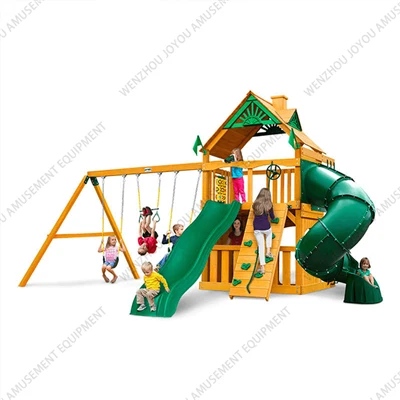
Repairing playground rope doesn’t have to be scary, and it doesn’t have to cost a fortune. The key is to match the materials, take your time, and don’t cut corners. And when you need a reliable supply of replacement ropes or help with a big project, you know where to find us. Let’s keep those playgrounds fun and safe, yeah?
Seesaw Playground References:
- Playground Safety Institute. (2022). Rope Inspection and Repair Guidelines for Outdoor Play Structures.
- National Recreation and Park Association. (2021). Low-Maintenance Playground Component Repair Best Practices.
- International Code Council. (2020). Playground Equipment Safety Standards for Rope Elements.
Wenzhou Joyou Amusement Equipment Co., Ltd.
As one of the most professional rope playground manufacturers and suppliers in China, we’re featured by quality products and good price. Please rest assured to buy customized rope playground made in China here from our factory. Welcome to contact us for pricelist.
Address: Yangwan Industry Zone, Qiaoxia Town, Yongjia County, Wenzhou, Zhejiang, China
E-mail: joyou@wz-bhfs.com
WebSite: https://www.best-playground.com/
